
MyCampus Eduservices now functions as a building block of the Microsoft 365 Education ecosystem, rather than as an isolated portal. The login relies on a single institutional Microsoft 365 account that also provides access to Outlook, Teams, SharePoint, and OneDrive through a single sign-on (SSO) mechanism. Understanding this architecture prevents most of the issues faced by students at the start of the school year or when changing devices.
Microsoft 365 SSO and MyCampus: what the unique identity changes
Before detailing the login steps, a technical point deserves attention. MyCampus does not assign a unique identifier: the email address provided by the institution (in the format [email protected]) serves as the entry key for all Microsoft 365 Education services.
This SSO has a direct consequence: a password issue on MyCampus also affects Outlook and Teams, and vice versa. Resetting the password on the Microsoft portal thus corrects access to all applications in the group, including MyCampus.
| Service | Identifier used | Authentication |
|---|---|---|
| MyCampus (mycampus.eduservices.org) | Institutional Microsoft 365 Email | SSO + MFA (if enabled) |
| Outlook / Teams / OneDrive | Same institutional email | SSO + MFA (if enabled) |
| Microsoft 365 Portal | Same institutional email | MFA recommended |
This table illustrates a point that classic guides overlook: there is only one set of credentials for the entire ecosystem. Looking for a distinct “MyCampus identifier” is a common mistake.
To access the MyCampus Eduservices login without issues, the first check should be the validity of the Microsoft 365 account itself, not the MyCampus platform as such.
Mobile multifactor authentication: set up Microsoft Authenticator before the school year
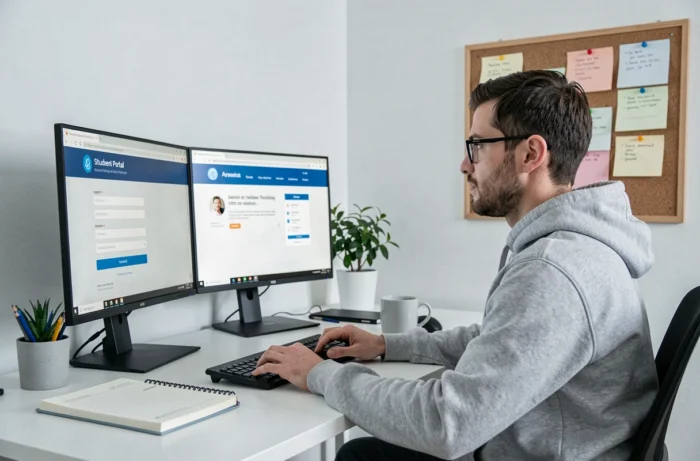
Since the summer of 2026, several schools in the Eduservices group have systematically activated multifactor authentication (MFA) for mobile logins. Without prior configuration of Microsoft Authenticator on the phone, logging into MyCampus from a smartphone becomes impossible, even with correct credentials.
The MFA adds a step after entering the password: a push notification or a temporary code generated by the app. This layer of security protects the account in case of password leakage, but it surprises students attempting to log in for the first time on mobile.
MFA configuration steps
- Install Microsoft Authenticator from your phone’s store (iOS or Android) before the first mobile login
- Log in for the first time from a desktop computer at mycampus.eduservices.org, then follow the MFA setup wizard provided by Microsoft
- Scan the QR code displayed on the screen with the Authenticator app to link the institutional account to the phone
- Validate the test notification sent by Microsoft to confirm that the second factor works
Configuring MFA on a computer before switching to mobile remains the most reliable method. Attempting to configure directly on a smartphone sometimes generates redirect loops between the browser and the app.
Compatible browser and MyCampus login: Edge and Chrome as priorities
Recent user feedback confirms that MyCampus is optimized for Edge and Chrome in their recent versions, both on desktop and smartphone. Using an outdated browser or a less common third-party browser can cause display errors on the Microsoft login page or even a complete block of SSO authentication.
On mobile, the default integrated browser (Samsung Internet, for example) may cause issues. In contrast, Edge and Chrome handle SSO redirects and MFA prompts correctly.
Verification points before contacting support
- Check that the browser is up to date (settings, then “About” or “Update”)
- Clear the cache and cookies related to microsoft.com and eduservices.org, as expired sessions block reconnection
- Temporarily disable ad-blocking extensions that sometimes intercept Microsoft authentication redirects
These three checks resolve the majority of cases reported as “MyCampus login issues” while the platform itself is functioning normally.
Lost password and reset: the Microsoft portal, not MyCampus
Since MyCampus uses the Microsoft 365 identity, the password reset does not occur on mycampus.eduservices.org. The “Can’t access your account?” link on the login page redirects to the Microsoft portal, which manages the recovery procedure.
If the institution has enabled self-service password reset (SSPR), the student can recover access by verifying their identity via a secondary email or a registered phone number. Otherwise, only the school’s IT service can unlock the account.
A detail often overlooked: resetting the Microsoft 365 password also changes access to Outlook and Teams. Remember to update the password in all connected applications (email client on smartphone, Teams app) to avoid cascading disconnections in the following hours.
The process of logging into MyCampus Eduservices boils down to three technical prerequisites: an active institutional Microsoft 365 account, MFA configured if required by the school, and an up-to-date compatible browser. Checking these three elements before the start of the school year eliminates nearly all reported blocks each year on student forums.