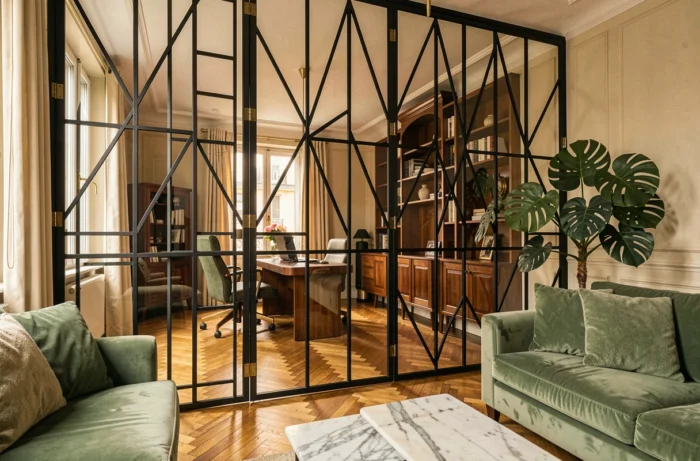
A black glass partition with identical rectangular panes is the classic workshop window. Change the arrangement of the crossbars, offset them, add a calculated asymmetry, and you shift into a completely different realm: that of the Art Deco window. This type of glass separation transforms a simple opening between two rooms into a fully decorative element, inspired by the geometric lines of the 1920s.
Asymmetrical crossbars and tinted glass: what defines the Art Deco style in windows
The Art Deco window, sometimes referred to as the Mondrian style, is based on a simple principle: the crossbars are not regular. They intersect at different heights, creating rectangles of varying sizes, sometimes an isolated square amidst elongated formats. This graphic play is directly inspired by Cubism and the Arts and Crafts movement that emerged after World War I.
Have you ever noticed that a standard workshop window cuts light into identical vertical strips? The Art Deco version breaks this repetition. It creates a visual effect akin to a painting, where each section of glass has its own format.
An article from Déco Factory published in 2026 highlights that the current Art Deco window is characterized by its asymmetrical crossbars, its shapes inspired by the 1920s, and the possibility of incorporating colored glass. This trend marks a clear break from the transparent industrial window. We see the emergence of smoked, bronze, or opalescent tinted glass that recalls contemporary stained glass, without the complexity of its production.
To explore the possibilities of arrangement and the atmospheres achievable, the Art Deco window on La Petite Maison dans la Prairie details several configurations suited to modern interiors.
Art Deco window between living room and kitchen: how to choose the location
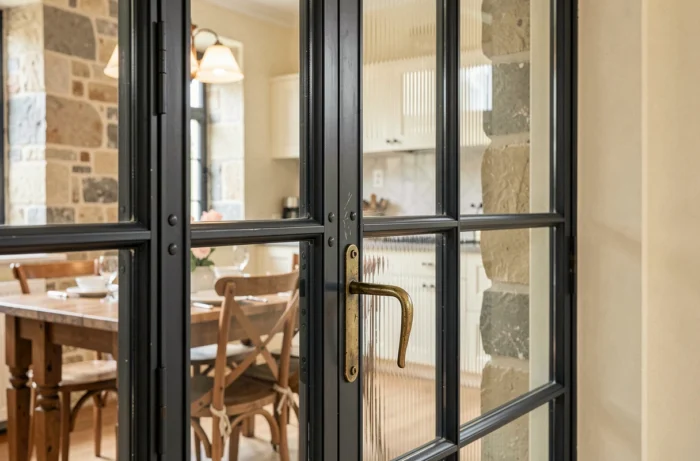
Why does this location come up so often? Because the living room-kitchen separation is the most common use case for a glass partition. The window serves two functions at once: it lets in light while marking the boundary between spaces.
In a living room open to the kitchen, an Art Deco window brings a visual structure that simply removing a partition does not provide. It frames the view and directs movement without blocking the perspective.
Adapting the composition to the volume of the room
A load-bearing wall with a narrow opening calls for a window with few, but well-positioned, crossbars. Multiplying divisions in a small area creates a cluttered effect that contradicts the elegance of the style.
Conversely, in a large opening (like an open kitchen), asymmetrical crossbars make perfect sense. They allow for a rhythm in a wide glazing without falling into the monotony of an industrial grid.
- For a narrow opening, favor two or three sections of contrasting sizes, with a single offset horizontal crossbar.
- For a wide opening, combine vertical and horizontal crossbars at irregular intervals to create a geometric pattern that is readable from a distance.
- If the room receives little natural light, opt for clear glass and reserve tinted glass for areas that are already well-lit.
Aluminum, steel, or wood: which material for an Art Deco window
The choice of material influences both aesthetics and durability. Each option imposes a different compromise.
Aluminum offers slim profiles and almost no maintenance. It is the most common material for current custom windows. It comes in many RAL colors, from deep black to anthracite gray to bright white.
Steel remains the historical material for workshop windows. It allows for very thin posts, which increases the glazed area. However, it requires anti-corrosion treatment and is heavier. Its raw aesthetic suits an interior that embraces an industrial side mixed with Art Deco vocabulary.
Wood brings a warmth that neither aluminum nor steel can replicate. It can be painted or varnished according to the desired ambiance. A dark-stained wooden frame with colored glass creates a look reminiscent of the woodwork found in private hotels from the 1920s.
Common mistakes with geometric stained glass and decorative windows
The trend for geometric stained glass in the Art Deco spirit in living spaces is accelerating. It is accompanied by recurring mistakes that individuals make out of enthusiasm.
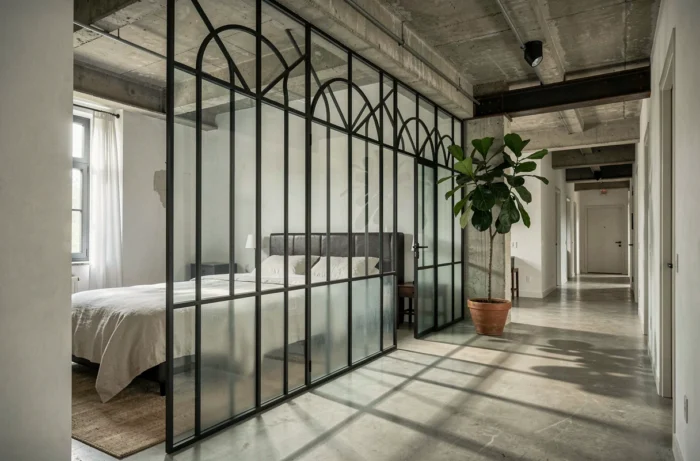
The first: mixing too many colors of glass in the same window. The Art Deco style relies on the sobriety of the pattern, not on chromatic accumulation. Two shades are sufficient, three at most. Beyond that, the effect shifts towards patchwork.
The second mistake concerns proportions. An Art Deco window works thanks to the contrast between large and small sections. If all the divisions are similar in size, the design loses its graphic tension and reverts to a banal grid.
- Limit colored glass to one or two strategic sections, with the rest in clear glass.
- Check that the pattern remains readable from three meters away; if not, simplify.
- Avoid overly thick crossbars on a small format: they crush the glazing and weigh down the overall look.
A sustainable arrangement, not a passing trend
The Art Deco style transcends decades without losing its relevance. The movement is nearly a century old and continues to inspire interior architecture. A well-designed Art Deco window does not go out of style, because it relies on timeless geometric principles rather than a trendy palette.
Custom solutions allow for adapting the composition to each interior, from the living room of an old apartment to the kitchen of a contemporary house. It is this adaptability that distinguishes the decorative window from a mere passing fad.