
Every summer, the same question arises with the first drought decrees: who has the power to prohibit the filling of a private pool in France? The answer is one word, the prefect, but the regulatory mechanics behind this decision have significantly evolved in recent years. A national framework now sets minimum rules that each department must apply, reducing local leeway while leaving areas of interpretation that complicate matters for individuals.
National minimum framework and pool filling: what has changed
The water restriction system in France is based on four levels of severity: vigilance, alert, reinforced alert, and crisis. Since 2026, these thresholds are accompanied by a national minimum table that is binding on the prefects. In practice, a prefect can tighten the measures outlined in this table, but cannot relax them.
Recommended read : Find out how to easily find out who owns a house in Belgium
For private pools, this table stipulates that filling is prohibited as soon as the alert threshold is reached. Refilling the pool can remain permitted until the reinforced alert. In a crisis situation, both filling and refilling are prohibited.
Before the establishment of this framework, disparities between departments were significant. A property owner could freely fill their pool in a department classified as being on alert, while their neighbor, just a few kilometers across the administrative boundary, faced a strict prohibition. The national table has reduced these discrepancies, though not eliminated them entirely. You can learn more on lebonsens.net about the decision-making chain that links the prefect, mayor, and drinking water manager.
Further reading : Discover the best solutions for sports equipment in Switzerland
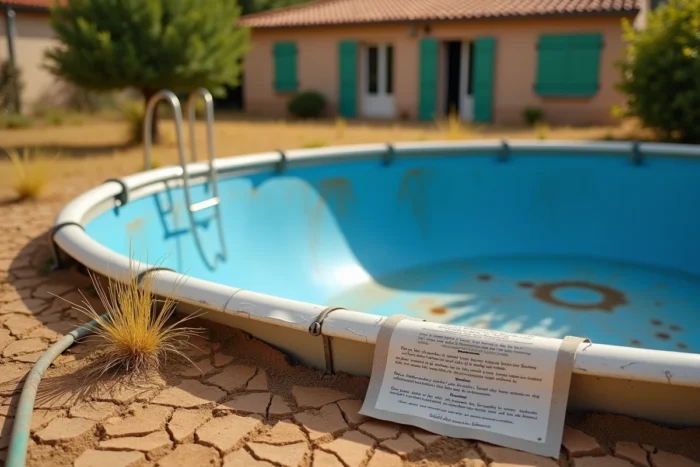
Prefectural drought decree: the role of the prefect and its limits
The prefect remains the authority who signs the water restriction decree applicable in their department. Their decision is based on the state of watercourses, groundwater, and watersheds. They divide the territory into zones, each of which may be at a different level of severity.
The publication of the decree goes through the collection of administrative acts from the prefecture and the Propluvia platform, which maps in real-time the restrictions in force from one municipality to another. A decree can evolve several times during the same summer if the hydrological situation deteriorates or improves.
Three recurring exceptions in the decrees
Most prefectural decrees provide for framed exemptions:
- The refilling of an existing pool, sometimes limited to certain hours (often at night), remains permitted during alerts in many departments.
- Wading pools of less than one cubic meter generally escape the prohibition, as their consumption is deemed negligible.
- The very first filling of a new or renovated pool may be authorized, provided that the work began before the date of publication of the decree.
These exceptions are not uniform. They depend on the wording of each decree, which explains the differences observed between Gironde, Moselle, or Yvelines, for example.
Mayor and drinking water manager: unknown decision-making relays
The prefect is not always the only one to intervene. Mayors or presidents of intercommunalities (EPCI) can take complementary decrees in their territory, provided they do not contradict the prefectural decree. A mayor can thus further restrict water use in their municipality, including for pools, if the local situation justifies it.
Some recent prefectural decrees also foresee the intervention of the drinking water manager. In this case, the manager may condition an exemption (for example, a first filling) on prior written authorization, adding an additional interlocutor in the decision-making chain.
This overlap of actors (prefect, mayor, manager) sometimes creates confusion. A property owner must check the prefectural decree and any municipal decree to know precisely the rules applicable to their address. Field feedback varies on this point: some municipalities display restrictions on their website, while others rely solely on the notice board at the town hall.

Sanctions and controls in case of prohibited filling
Filling a pool in violation of a drought decree constitutes a fifth-class offense. The fine can reach up to 1,500 euros for an individual. In case of repeat offenses, this amount can be doubled.
Controls are carried out by agents from the French Office for Biodiversity (OFB), gendarmes, municipal police, or water service agents. In practice, the frequency of these controls varies greatly depending on the departments and available resources.
How to check the restrictions applicable to your municipality
The Propluvia platform, managed by the Ministry of Ecological Transition, remains the official source. It allows you to consult the level of restriction in force by geographical area. Each prefecture also publishes its decrees on its website, with annexes detailing the exceptions.
- Consult Propluvia to know the level of vigilance, alert, or crisis in your municipality.
- Read the current prefectural decree, which details the prohibited uses and possible exemptions for pools.
- Check with the town hall if a municipal decree adds any additional local restrictions.
The situation can change rapidly. A department can move from vigilance to reinforced alert in a few days if precipitation remains insufficient. Checking the restrictions before any filling or refilling avoids a fine, but also a neighborhood conflict in areas where water resources are becoming an increasingly tense issue.
The French system entrusts the final decision to the prefect, framed by a national foundation that limits disparities. Mayors and water managers complement this system at the local level. For a pool owner, the best practice remains to cross-reference the prefectural decree with any municipal provisions before turning on the tap.