
Identifying the owner of a property in Belgium involves navigating through several databases managed by the SPF Finances. Cadastre, mortgage registry, notarial deed: each source provides different information, with varying levels of access and costs. Knowing which one to query, and in what order, helps avoid wasting time and money.
Cadastre, mortgages, and notarial deed: three sources compared
In Belgium, information on real estate is divided among three distinct documents, all managed by the General Administration of Heritage Documentation (AGDP) of the SPF Finances. None of them provide exactly the same information.
Further reading : How to Easily Resolve Connection Errors on Logisfil: A Practical Guide
| Source | Data provided | Access for individuals | Cost |
|---|---|---|---|
| Cadastre (cadastral extract) | Identification of the parcel, cadastral income, name of the registered owner | Online via MyMinfin or at the regional office | Free via MyMinfin for one’s own properties, paid for a third party |
| Mortgage registry | History of transactions, mortgage charges, real rights | By written request to the competent office | Paid (search and copy fees) |
| Notarial deed (transcription) | Complete details of the sale or donation, identity of the parties, price | Via the acting notary or the registry | Variable depending on the complexity of the search |
The cadastre remains the quickest entry point to identify an owner. However, it does not provide the purchase price or the existence of a mortgage. For this data, the mortgage registry is the reference.
If you are looking for how to find out who owns a house as part of a purchase project or a neighborhood dispute, the cadastral approach is sufficient in most cases. Mortgage searches are more suited for notaries, lawyers, or creditors.
Related reading : How to Get a Live Aerial Photo of My House from Satellite
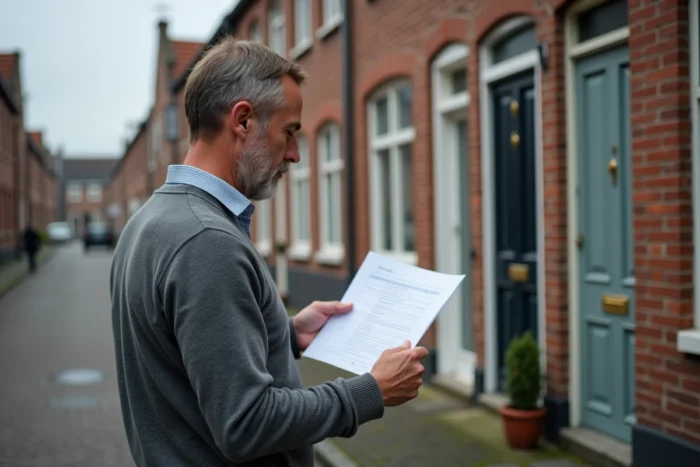
Cadastral extract in Belgium: process via MyMinfin
The MyMinfin platform, accessible with an electronic identity card or via itsme, allows you to consult the cadastral parcel plan and order an extract. For one’s own properties, consultation is free. For a property belonging to a third party, a legitimate interest must be justified and administrative fees paid.
The cadastral extract mentions the name of the registered owner, the nature of the property (house, land, apartment), its cadastral area, and its cadastral income. The latter is indexed each year via a coefficient published by the tax administration.
Two limitations to be aware of:
- The cadastre reflects the situation at the time of the last update. A recent purchase may not yet be recorded if the deed has not been transcribed.
- The extract does not mention mortgage charges or easements, which fall under the mortgage registry.
- In the case of co-ownership, only the owner of the share appears, not the other co-owners of the building.
For new properties, the owner must declare the housing to the AGDP within 30 days of starting to use it. This obligation creates a recent and reliable administrative entry point for identification.
Mortgage registry: when the cadastre is not enough
The mortgage registry records every real estate transaction (sale, donation, inheritance) as well as mortgage registrations. It is the most comprehensive source for tracing the ownership history of a house in Belgium.
An individual can request a mortgage statement, but the procedure is more cumbersome than a simple cadastral consultation. The request is made in writing to the competent registry office (determined by the location of the property). The timeframes vary from a few days to several weeks depending on the office’s workload.
The mortgage statement reveals the amount of the loan still registered on the property, any potential seizures, and real rights such as usufruct or easements. This information is absent from the cadastre. For a real estate purchase, a notary systematically queries this database before drafting the deed of sale.
Special case of the State Archives
To go further back in time, the State Archives hold old cadastral registers, matrices, and plans dating back sometimes several centuries. These documents allow tracing the ownership history of a residence well beyond the current digital registers. This process is more about historical research than a common legal need.
Cadastral income and owner identification: the tax link
Cadastral income (RC) is not only used for calculating property tax. It also serves as an identification marker for the owner, as any modification of the RC (reassessment, dispute, new construction) generates a notification sent to the registered holder.
In Belgium, the RC must legally be revised every ten years to limit disparities between properties. After each revision, the owner has a two-month period to contest the new estimate. This procedure creates a dated administrative record, useful for confirming the identity of the current owner.
The annual indexing of the RC (via a multiplier coefficient) does not trigger individual notification, but the indexed value appears on the tax notice sent each year to the owner. This tax document remains one of the most reliable indirect means to verify who owns a property at a given date.

The most effective approach to identify the owner of a house in Belgium almost always starts with the cadastral extract via MyMinfin. If the property is involved in a dispute, a complex inheritance, or a purchase, going through the mortgage registry and a notary becomes necessary. The cadastre provides the name, while the mortgages tell the complete story of the property.