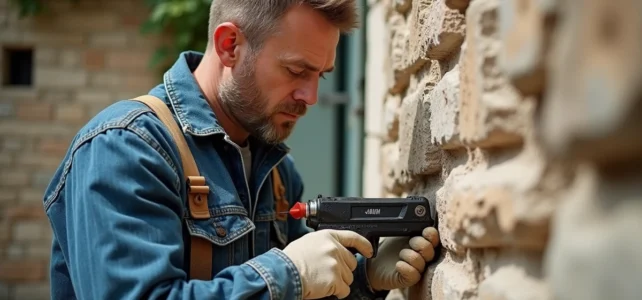
Installing a pergola plate on a tuffeau wall or anchoring a wooden post on a stone wall is not the same action as setting it in solid concrete. The support changes everything: porosity, modulus of elasticity, chemical reaction with the resin. When working with wood or natural stone, the choice of chemical anchoring mortar and the preparation of the hole directly affect the durability of the fixation over time.
Epoxy or vinylester resin: compatibility based on the type of natural stone
All natural stones are often grouped under the same label, but granite and tuffeau do not react the same way to anchoring resin. The distinction between hard stone and soft stone is the first criterion to validate before choosing your mortar.
See also : Tips and Tricks for a Fulfilling Family Life Every Day
Pure epoxy resins are suitable for hard stones like granite, basalt, or quartzite. The modulus of elasticity of these rocks is close to that of the cured resin, which limits internal stresses after polymerization. On these supports, epoxy offers the best resistance to pull-out.
For soft limestone stones (tuffeau, Caen stone, certain sandstones), it’s a different matter. Pure epoxy, being too rigid, generates differential expansion with the support. The result: superficial micro-cracking of the stone after polymerization, sometimes visible to the naked eye a few weeks later.
Recommended read : The Latest Trends and Essential Tips in the World of Computing
For these soft stones, the choice leans towards a styrene-free vinylester resin. It polymerizes without generating excessive stresses and adapts better to the relative flexibility of limestone. It is also the least aggressive formulation for porous supports, as it does not release volatile compounds that could stain the stone’s surface.
A detailed guide on chemical anchoring for wood and natural stone confirms this distribution and specifies the cases where the use of an injection sieve becomes necessary to prevent the resin from migrating into the stone’s capillaries.
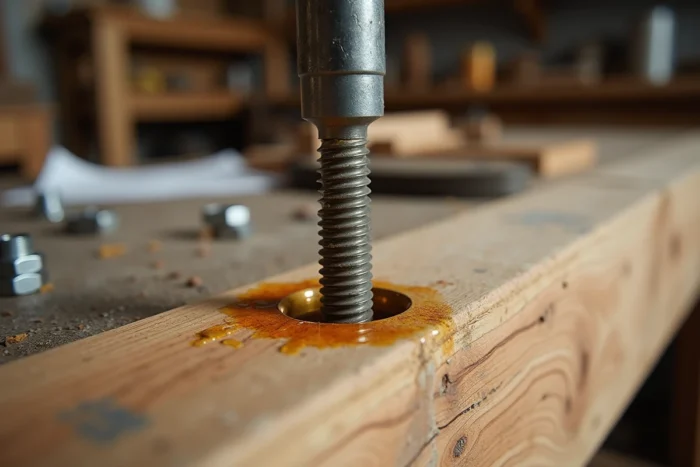
Chemical anchoring in wood: hybrid resins and suitable drilling
Wood is an anisotropic material: its fibers direct mechanical resistance in a specific direction. A chemical anchoring in solid wood only works if this structure is taken into account.
Choosing the resin for a wood support
Classic polyester resins adhere poorly to wood fibers and do not tolerate the micro-movements related to humidity variations. Hybrid resins (polyurethane-epoxy or modified vinylester) are better suited, as they retain slight elasticity after curing. This residual flexibility absorbs seasonal swelling and shrinkage of the wood without delaminating.
Preparing the drilling hole
In wood, drilling produces fibrous chips that line the walls of the hole. If the resin is injected without cleaning, adhesion drops significantly. Here is the sequence to follow:
- Drill with a wood drill bit (not a concrete drill) at the exact diameter recommended by the cartridge manufacturer, to avoid a hole that is too smooth or too wide
- Blow out the hole with compressed air or a blowing bulb, then use a brush to remove residual fibers stuck to the walls
- If the wood is damp (exterior wood, post in contact with the ground), check that the chosen resin tolerates a non-dry support, as most standard epoxies do not cure properly beyond a certain humidity level
- Inject the resin from the bottom of the hole towards the opening to avoid air pockets, then insert the stainless steel threaded rod while slightly turning it
Feedback varies on long-term performance in wood exposed to the elements. Outdoors, prior treatment of the wood (minimum class 4) and a stainless steel A4 threaded rod reduce the risks of premature degradation of the anchoring.
Common mistakes with natural stone and wood: what causes an anchoring failure
The same causes of failure are often seen on construction sites. Two of them recur more than others, and they have nothing to do with the quality of the resin.
Poorly calibrated or poorly cleaned hole
In porous natural stone, a hole drilled with a hammer drill with too strong percussion can fracture the support around the drilling. The resin then fills micro-cracks instead of bonding to a sound surface. Switching to pure rotation mode on soft stones protects the integrity of the support.
In wood, a hole that is too wide relative to the threaded rod leaves an excessive thickness of resin. However, anchoring resin is not designed to fill large volumes: it works as an adhesion film, not as structural filling.
Failure to respect the curing time
Loading a fixation before the resin has fully cured is the most common cause of failed anchoring. Ambient temperature plays a direct role: below 10 °C, the curing time can double or even triple depending on the formulations. Always check the manufacturer’s technical data sheet for the temperature range before planning the load application.

Stainless steel threaded rod and sieve: hardware suited to the support
Choosing the resin is not enough. The peripheral hardware also determines the durability of the anchoring.
On natural stone, and particularly on hollow or semi-hollow stones, a nylon injection sieve prevents the resin from flowing into the material’s cavities. Without a sieve, the cartridge is emptied without achieving mechanical grip. On solid and dense stone (granite, slate), the sieve is generally unnecessary.
For the threaded rod, stainless steel A2 is suitable indoors, stainless steel A4 for outdoors or in humid environments. On autoclaved treated wood, stainless steel A4 is preferable as wood treatment salts accelerate the corrosion of standard galvanized steel.
On the extrusion gun side, a rack model with a compression ratio suitable for bi-component cartridges ensures a homogeneous resin-hardener mix. A low-end gun that delivers an irregular flow produces poorly dosed mortar, compromising polymerization in the hole.
Chemical anchoring on wood and natural stone requires more rigor than on concrete, simply because these supports are less forgiving of approximations. Adapting the resin to the material, calibrating the drilling, and respecting the curing time remain the three concrete levers for achieving a reliable anchoring on these demanding supports.