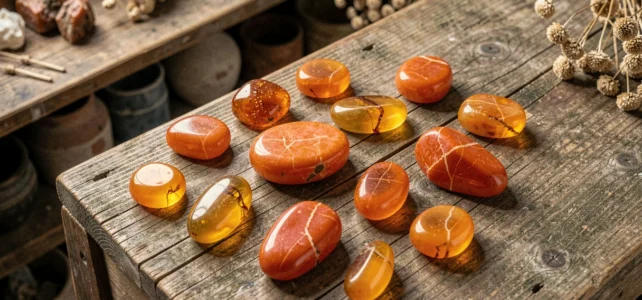
The orange color of a natural stone comes from the presence of specific chemical elements in its crystalline structure, primarily iron and manganese. These elements absorb certain wavelengths of visible light and reflect a spectrum ranging from pale peach to bright orange, known as “mandarin.” Understanding this mechanism allows for the distinction between different orange stones and a more accurate assessment of their quality.
Origin of the orange color in minerals
The orange in a stone results from a phenomenon of selective light absorption. When white light passes through a crystal containing ferric iron (Fe³⁺) or manganese (Mn²⁺), certain wavelengths are absorbed. The remaining spectrum, reflected back to the eye, produces the orange hue.
See also : Tips and Tricks for a Fulfilling Family Life Every Day
The carnelian derives its color from micro-inclusions of iron oxides dispersed in a microcrystalline quartz matrix (chalcedony). The spessartite garnet, on the other hand, owes its orange to manganese incorporated directly into its chemical formula. Fire opal works differently: its color comes from the diffusion of light in hydrated silica spheres, combined with traces of iron.
These distinct mechanisms explain why not all orange stones have the same brilliance, transparency, or color stability over time. A carnelian may darken slightly under prolonged light, while a spessartite retains its hue without alteration.
Related reading : Discover the Unexpected Health and Wellness Benefits of Whisky
For those wishing to delve deeper into the symbolism associated with these gems, it is possible to learn more on binnews.info about the traditional meanings attributed to orange stones.
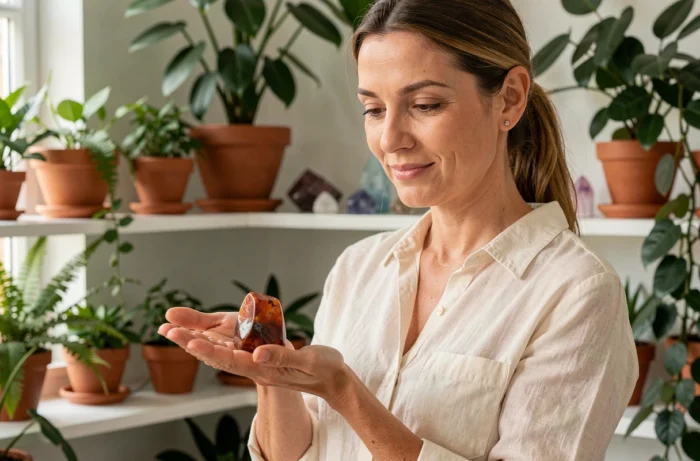
Mandarin spessartite garnet: the most sought-after orange stone in jewelry
Among all orange stones, the mandarin variety of spessartite garnet holds a special place in the high jewelry market. According to the GemGuide (August 2026), this gem is among those that “perform best” at recent trade shows.
The premium on spessartites of pure orange, without brown or red tones, is considerable. These stones can sell for more than double the price of other spessartites of comparable quality. The determining criterion is saturation: a bright, pure orange, without drifting towards brown, red, or yellow.
A concrete example of this dynamic
A Harry Winston ring set with a very high-quality orange spessartite was auctioned well above its estimate at a Christie’s sale in September 2024. This result illustrates the growing appetite of collectors for large, high-quality orange stones.
This trend extends beyond just spessartite. The GemGuide notes a rise in prices across the entire category of orange gems, driven by increased global interest. Online content discusses chakras and virtues extensively, but this economic reality gives orange stones an additional, tangible dimension.
Carnelian, fire opal, and imperial topaz: compared properties
Choosing an orange stone requires understanding the concrete differences between the main options available. Here are the characteristics that separate them mineralogically and practically.
- The carnelian is a microcrystalline quartz (chalcedony), semi-translucent, with a hardness of 7 on the Mohs scale. It is the most accessible orange stone in terms of price. It can be worn daily without special precautions and withstands light shocks well.
- The fire opal is a hydrated silica, often transparent to translucent, with a hardness between 5.5 and 6.5. Its water content makes it sensitive to dehydration and thermal shocks. It requires more careful maintenance, particularly avoiding prolonged exposure to dry heat.
- The imperial topaz is a fluorinated aluminum silicate, transparent, with a hardness of 8. Its color ranges from yellow-orange to pink-orange. Harder and more stable than fire opal, it is suitable for fine jewelry but remains sensitive to cleavage (fracture along a crystal plane).
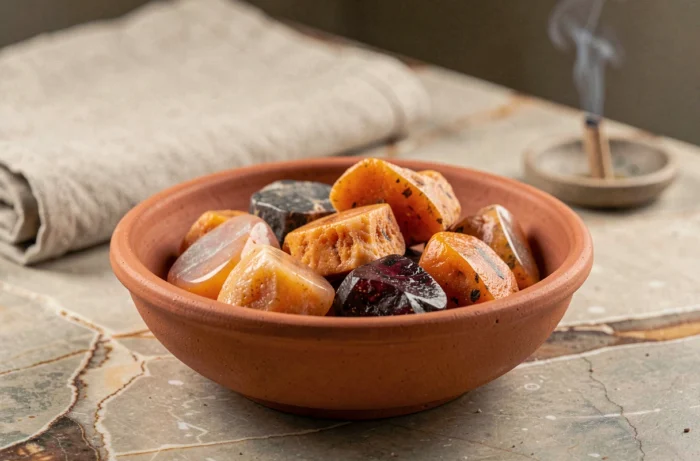
The choice between these three stones depends on the intended use. For a piece of jewelry worn daily, carnelian offers the best compromise between durability and cost. For a collector’s piece or exceptional jewelry, imperial topaz and mandarin spessartite are more justified.
Meanings and virtues attributed to orange stones in lithotherapy
In lithotherapy, orange stones are associated with the second chakra, known as the sacral chakra, located below the navel. Practitioners attribute properties related to creativity, vitality, and emotional balance to them.
Carnelian is the most commonly used stone in this context. It is believed to stimulate confidence and promote spontaneity. Sunstone, a feldspar with coppery reflections, is associated with joy and optimism.
What recent studies say about the color orange
Beyond lithotherapy, color psychology provides complementary insights. A study published in PubMed Central (PMC, 2025-2026) explored the effects of the color orange on emotions. The results suggest that exposure to this hue tends to promote positive emotional states, although the precise mechanisms remain to be documented.
This convergence between lithotherapeutic tradition and contemporary research does not validate the therapeutic virtues attributed to stones. However, it shows that human attraction to the color orange is based on measurable psychological foundations, beyond mere aesthetic preference.
Care for orange stones: precautions based on the mineral
Not all orange stones can withstand the same treatment. Maintenance directly depends on the chemical composition and hardness of the mineral.
- Carnelian and orange quartz can be cleaned with warm soapy water, with no particular risk. Rinse and dry with a soft cloth.
- Fire opal should never be immersed in an ultrasonic bath. Avoid sudden temperature changes and store in a slightly humid environment to prevent dehydration.
- Imperial topaz withstands standard cleaning well but is sensitive to direct shocks on the edges due to its natural cleavage.
- Spessartite garnet tolerates most cleaning methods, including gentle steam, due to its hardness of 7 to 7.5.
A poorly maintained piece of jewelry loses its luster, sometimes irreversibly in the case of opal. Adapting cleaning to the mineral remains the most cost-effective precaution in the long run.