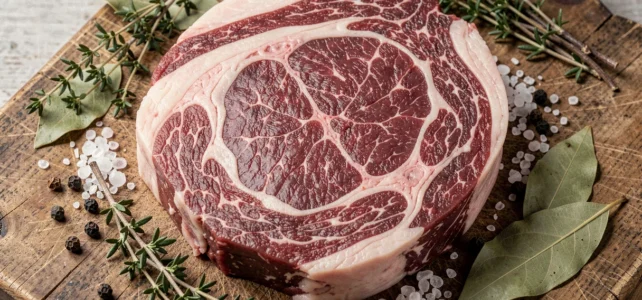
A poorly cooked round of veal, we all know the result: a dry, fibrous slice that resists the bite despite what seemed like proper cooking. This piece from the flank of the beef thigh concentrates a lot of collagen. It is precisely this collagen that can become an ally or an enemy depending on the method used.
Collagen in the round of veal: understanding what makes cooking so delicate
The round of veal belongs to the thigh muscles, an area of the beef that is heavily used by the animal during its life. The result: the muscle fibers are dense, crossed by a network of connective tissue rich in collagen.
Recommended read : The Latest Trends and Essential Tips in the World of Computing
Where a tenderloin (a less worked muscle) offers natural tenderness, the round of veal requires that we transform this collagen into gelatin. This transformation only occurs under certain conditions of temperature and duration. Too hot, too fast, and the fibers contract violently while the collagen remains intact. You end up with meat that is both tough and dry.
For those who want to delve deeper into the basics of this cut of beef before heading to the kitchen, you can discover the round of veal on Les Bricoles De Louve in a comprehensive guide.
You may also like : Tips and Tricks for a Fulfilling Family Life Every Day
Low-temperature oven cooking: the most reliable method for tender round of veal
We often hear about low-temperature cooking for beef roasts, but rarely with the settings suitable for a cut as collagen-rich as the round of veal. The temperature window that yields the best results is around 80 °C in a humid environment.
The principle of simmering without boiling
The goal is simple: maintain a very light simmer of the cooking liquid, without ever reaching a full boil. We aim for a broth that “vibrates” barely. At this temperature, the collagen gradually transforms into gelatin, which lubricates the muscle fibers instead of drying them out.
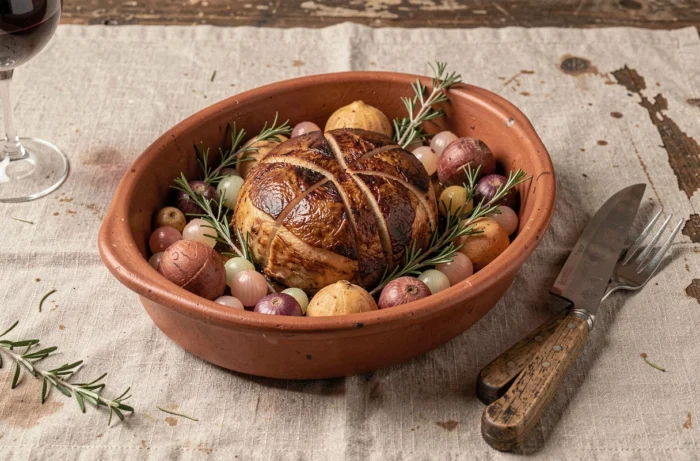
Specifically, we place the round of veal in a pot with a base of broth, wine, or simply flavored water. We put it in the oven at low temperature and let time do the work. The duration depends on the thickness of the piece, but we are talking about several hours, not a few minutes per kilo as with a classic roast.
Why avoid classic high-temperature recipes
General cooking guides often recommend an oven above 200 °C followed by a time per kilo. This scheme works for a tenderloin or a sirloin, not for a round of veal. The thigh muscles do not have the same structure. Applying the same logic is like trying to solve two different problems with the same tool.
- At high temperature, the fibers contract and expel their juices in a few minutes, without giving the collagen time to melt.
- In slow cooking around 80 °C, the collagen converts to gelatin, resulting in a melting texture and a naturally creamy juice.
- The risk of intermediate cooking (around 120-140 °C) is to get the worst of both worlds: already contracted fibers and barely touched collagen.
Vacuum cooking of the round of veal: the trap of too long a time
Vacuum cooking seems like the ideal solution to control the temperature to the exact degree. And for many cuts, this is indeed the case. However, for a highly collagen-rich muscle like the round of veal, the reality is more nuanced.
Recent feedback from chefs practicing sous-vide shows a clear limit. Beyond about twenty-four hours in a moderately warm bath, the texture turns mushy or floury. The collagen is well transformed, but the muscle fibers have completely disintegrated. The result is no longer pleasant in the mouth.
The temptation, when starting with sous-vide, is to extend the duration “to be sure.” With a round of veal, this reflex is precisely what produces disappointing meat. It is necessary to finely adjust the time-temperature pair rather than extending it for safety. Feedback varies on this point depending on the exact thickness of the piece and the equipment used.
Preparing the round of veal before cooking: the steps that change the result
Even before turning on the oven or putting it in a vacuum bag, a few preliminary steps condition the final tenderness.
Bringing the meat to room temperature
A cold piece at the center takes much longer to reach the target temperature. During this time, the outside cooks too much and the peripheral fibers tighten. Taking the round of veal out well before cooking allows for a more even temperature rise.
Searing before slow cooking
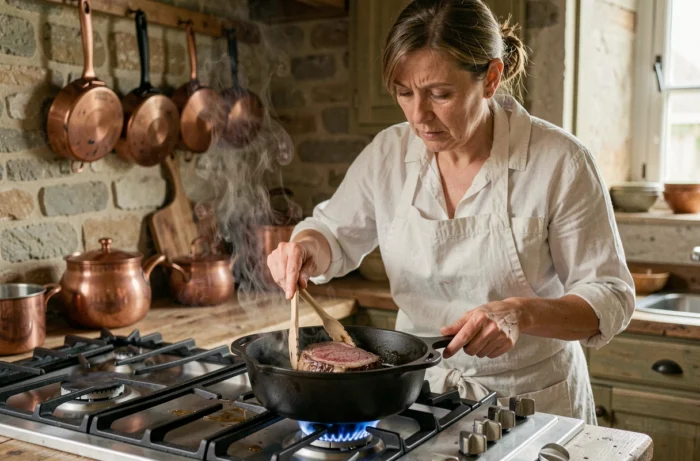
We sear the piece over high heat in a pan or pot for a few minutes on each side. This is not to “seal in the juices” (this myth is persistent), but to achieve the Maillard reactions that develop complex aromas on the surface. These aromatic compounds then enrich the braising juice during the long cooking.
- Use a fat that can withstand high heat (neutral oil, clarified butter) and not raw butter that burns quickly.
- Do not move the meat during searing: place it, wait for the crust, then turn it.
- Deglaze the pot after searing with wine, broth, or vinegar to recover all the caramelized juices.
Resting and slicing: two steps often overlooked in a beef roast
We invest time in cooking, then slice immediately. This is a common mistake. After long cooking, the juices are in motion within the piece. Letting the meat rest allows the fibers to relax and the juices to redistribute.
We cover the round of veal with a sheet of aluminum foil and wait. The resting time varies depending on the size of the piece, but it should not be neglected.
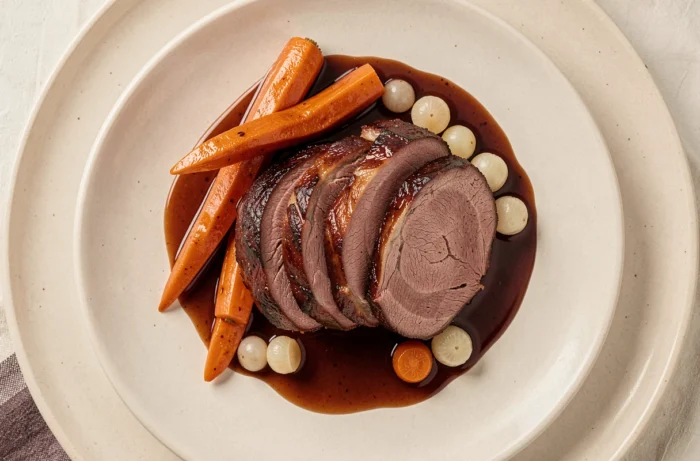
The slicing also matters. On a fiber-rich piece like the round of veal, we slice perpendicular to the direction of the fibers. Cutting with the grain means asking the teeth to do the work that the knife did not do. Thin slices cut against the grain give a sensation of tenderness even on a piece that is still slightly firm.
The round of veal is not the easiest cut to master, but that is precisely why it rewards patience and method. Gentle cooking, a good rest, careful slicing: three accessible steps that transform an economical cut into a generous dish.