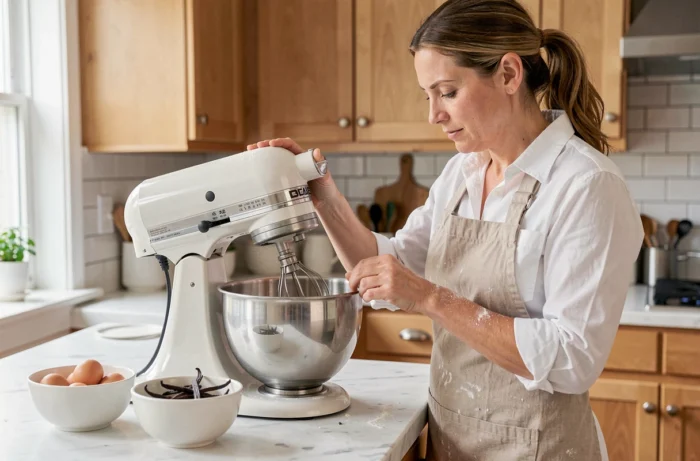
A stand mixer is a vertical motorized appliance equipped with a fixed bowl and interchangeable whisks, designed for kneading, beating, and mixing. A Thermomix is a multifunctional cooking robot with a heating bowl and rotating blades, capable of blending, cooking, weighing, and emulsifying. These two machines follow opposing design logics, and confusing them often leads to an unsuitable purchase.
Accessory Compatibility and Model Locking
A rarely discussed point in comparisons concerns accessory compatibility between generations of the same device. At Thermomix, several recent accessories designed for the TM7 do not work with the TM6, and vice versa. This model locking means that a change in generation can render part of the already purchased equipment obsolete.
Stand mixers from brands like KitchenAid or Kenwood take a different approach. Accessories (kneading hooks, whisks, choppers) generally remain compatible across ranges for several years. This reduces the total cost of ownership in the long run.
Understanding the differences between stand mixers and Thermomix also involves this often-overlooked economic dimension: the initial purchase price does not reflect the actual cost if accessories become incompatible over time due to manufacturer updates.
Stand Mixer and Thermomix: Two Distinct Architectures
The stand mixer uses a planetary motion: the whisk rotates on itself while describing an orbit around the bowl. This mechanism ensures even kneading of heavy doughs (bread, brioche, pizza) and effective aeration of egg whites or cream.
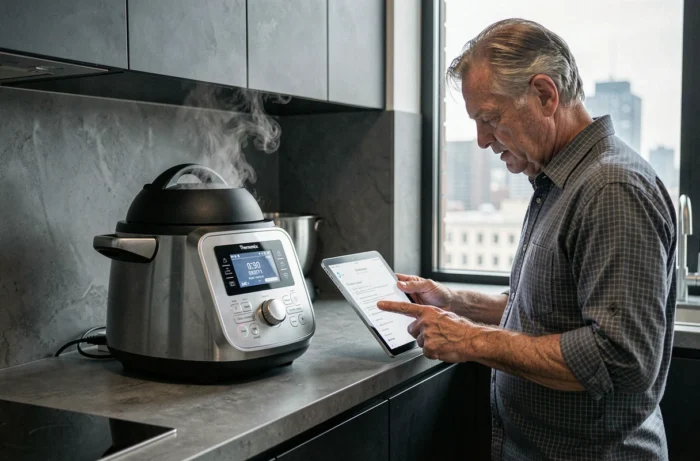
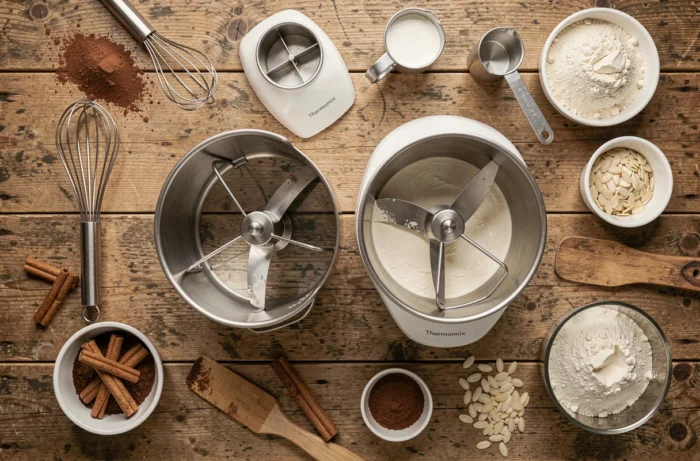
The Thermomix operates with blades at the bottom of a closed bowl. High-speed rotation allows for blending, chopping, and emulsifying. A heating element integrated into the bowl adds cooking capabilities, making it a multifunctional cooking robot.
Consequences on Textures Achieved
For yeast doughs or meringues, the planetary motion of the stand mixer incorporates more air. The result is lighter and more structured. The Thermomix, with its blades, processes preparations differently: it excels at soups, smooth purées, compotes, and emulsified sauces.
A stand mixer kneads better, while a Thermomix cooks and blends better. Neither fully replaces the other in their respective domains.
Integrated or Absent Cooking: The Criterion that Separates Uses
Cooking is the clearest dividing line. The Thermomix heats its bowl to temperatures that allow for making risottos, fondues, jams, or steaming thanks to its dedicated basket. A classic stand mixer does not heat.
This cooking capability transforms the Thermomix into an all-in-one device for everyday meals. However, it introduces a constraint: the single bowl limits parallel work. Preparing a cake batter and then moving on to a sauce requires emptying, cleaning, and reloading the bowl between each step.
With a stand mixer, the bowl can operate while a pot heats on the stove. Parallel preparation remains possible, which suits cooks accustomed to managing multiple tasks simultaneously.
Guided Recipes and Kitchen Autonomy: Two Philosophies
The Thermomix offers a connected touchscreen with access to thousands of step-by-step guided recipes. Each step indicates the temperature, speed, and duration. This system is suitable for beginners in the kitchen or those who want to replicate recipes without improvising.
The stand mixer does not provide guidance. It delivers mechanical power; the rest depends on the cook. This lack of guidance is an advantage for those who master their recipes and want to freely adjust textures.
Connectivity and Software Updates
The Thermomix receives software updates and new recipes via Wi-Fi. Starting in 2027, the new EU machinery regulation will introduce specific requirements for cybersecurity for connected devices. This regulatory framework could influence how manufacturers manage data and updates for connected cooking robots.
A mechanical stand mixer, on the other hand, has no software dependency. It operates as long as the motor runs.
Choosing Between Stand Mixer and Thermomix: Concrete Criteria
The choice depends on three main variables:
- The type of priority preparations. If baking (yeast doughs, meringues, whipped creams) represents the majority of use, the stand mixer is more suitable. If soups, stews, and steaming dominate, the Thermomix has the advantage.
- The available space in the kitchen. The Thermomix can potentially replace several appliances (scale, blender, steamer), freeing up counter space. The stand mixer occupies a fixed spot but requires additional appliances for cooking.
- The long-term budget. The stand mixer generally costs less upfront, and its accessories remain compatible longer. The Thermomix represents a higher initial investment, increased by the potential renewal of accessories with each new generation.
One last element deserves attention: the European regulation stipulates that instructions may be provided in digital format rather than paper for certain devices. For a connected cooking robot, this means that access to documentation will depend on the longevity of the manufacturer’s servers, a factor to consider before a long-term purchase.