
A smudged line, a signature spread across a document, stained fingers after a few lines of notes: the ballpoint pen remains the most common writing tool, but not all are equal when it comes to the problem of smudging. The choice of the right combination of ink, tip, and paper determines the clarity of the result, much more than the brand or the price displayed on the packaging.
Oil-based ink or hybrid ink: what changes for smudges
Classic ballpoint pens use a viscous oil-based ink that dries quickly upon contact with paper. It is this viscosity that naturally limits spreading. Gel inks, which are more fluid, offer a smoother line but take longer to dry, increasing the risk of smudges under the hand.
Between these two families, hybrid inks attempt to combine the fluidity of gel with the quick drying of classic ballpoint ink. Since 2024, several manufacturers have introduced “fast-dry” formulations that directly target the problem of smudging, especially for left-handed users. The Zebra Sarasa Dry, for example, is marketed as a gel pen whose ink dries significantly faster than conventional gel inks, leaving no smudges even when the hand passes immediately over the writing.
For those looking to avoid smudges with a ballpoint pen, the first instinct is to check the ink base: an oily or hybrid formulation will almost always be more reliable than a classic gel ink on standard office paper.

Ballpoint tip diameter: the underestimated parameter
The diameter of the ball directly influences the amount of ink deposited with each stroke. A fine tip (0.5 mm or less) deposits less ink and mechanically reduces the risk of spreading. Conversely, a wide tip (1 mm and above) releases a more generous flow, suitable for thick lines but more prone to smudges on thin paper.
The medium tip, around 0.7 mm, is the most common compromise for everyday use. It offers a readable line without excess ink. Field feedback varies on this point: some users prefer a fine tip for quick notes, while others find the writing too dry and uncomfortable during long sessions.
What the ball size doesn’t tell you
The diameter alone guarantees nothing. The machining quality of the ball and the precision of its housing in the cone determine the consistency of the flow. A low-quality pen with a poorly adjusted ball can leave “clumps” of ink in certain places along the line, even with a fine tip. A well-machined ball mechanism produces a constant flow, which reduces the clumps responsible for localized smudges.
The role of paper in ballpoint pen smudges
The best ballpoint pen in the world will smudge on unsuitable paper. Ink behaves differently depending on the porosity and weight of the sheet.
- Paper that is too thin or too porous absorbs ink unevenly, causing a “blotter” effect with blurred edges and sometimes ink transfer to the back.
- Standard office paper (with a sufficiently dense weight and smooth surface) limits absorption and allows the ink to dry on the surface, resulting in a clean line.
- Coated or glossy papers, used for certain marketing documents, repel oil-based ink and extend drying time, with a risk of smudges if the sheet is handled too quickly.
The ink-paper interaction is as important as the pen itself. Testing a pen on the paper you actually use, rather than on a demonstration pad in the store, provides a much more reliable picture of daily results.
Writing pressure and gestures: the human variable
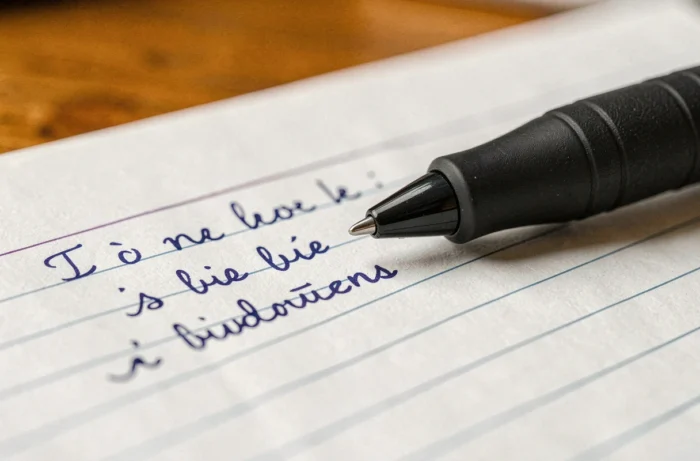
Pressing hard on a ballpoint pen increases the ink flow and encourages accumulation at the tip. People who write with significant pressure often notice ink clumps at the beginning or end of a word, where the pen pauses on the paper.
Left-handed users face an additional challenge: their hand passes over the freshly written text, smudging the ink before it has fully dried. Fast-dry inks specifically target this problem, but they are more common in gel and hybrid ranges than in traditional oil-based ballpoints. Left-handed users who prefer classic ballpoint pens should combine a fine tip with low-absorbent paper to minimize marks.
Writing speed and temperature
Writing quickly accentuates smudges because the ball turns faster and releases more ink in a short time. Heat also plays a role: oil-based ink becomes slightly more fluid in warm weather, which alters the pen’s behavior. Available data does not allow for precise quantification of this phenomenon, but it is regularly reported by users during the summer months.
Environmental labels and ink composition: a recent angle
Regulatory constraints on ink composition are evolving. In Europe, the Blauer Engel (Blue Angel) label, issued by the German Federal Environment Agency, imposes strict limits on certain components of pen inks, particularly organic solvents and dyes.
These restrictions influence ink formulation, including their viscosity and drying time. An ink reformulated to meet environmental specifications does not necessarily behave like its conventional counterpart. This parameter is still poorly documented in consumer buying guides, but it deserves attention if you purchase certified supplies and notice different ink behavior from what you were familiar with.
Choosing a ballpoint pen that does not smudge rarely comes down to a single criterion. The viscosity of the ink, the diameter and quality of the tip, the type of paper used, and the pressure of the hand form a system. Modifying any one of these elements can be enough to solve the problem or, conversely, shift it. Testing on your own paper, with your own gestures, remains the most reliable method to decide.