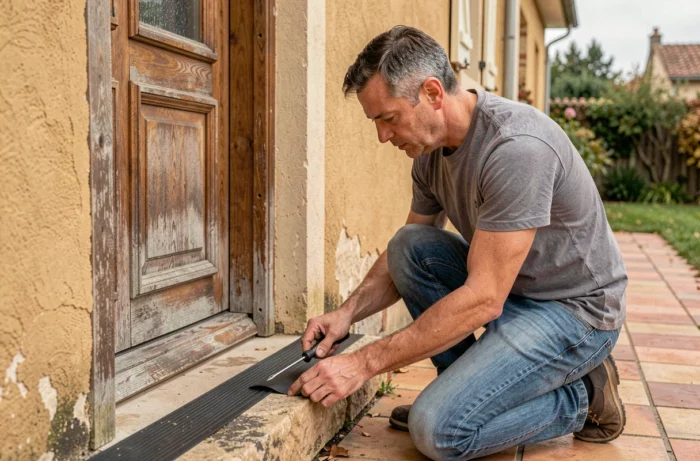
A rain barrier refers to any physical device placed in front of a home’s openings (doors, garage thresholds, basement windows) to prevent runoff or floodwater from entering. The term encompasses both emergency-stacked sandbags and removable aluminum flood barriers designed for repeated use.
The difference between a barrier that holds and one that fails lies less in the material than in the preparation of the support and the quality of the ground sealing.
Performance standard and absence of French standards for flood barriers
No French or European standard currently defines the expected performance of a removable flood barrier. This gap makes products sold in France difficult to compare, as each manufacturer can present its own criteria.
Rigorous manufacturers refer to the American standard ANSI/FM 2510, published in September 2020. This reference sets a maximum leakage of about one liter per hour per meter of joint, measured over a fifteen-minute test. Before purchasing or manufacturing a barrier, requesting a dated and quantified test report from the manufacturer remains the only reliable way to assess the actual performance of the device.
When looking to install an effective rain barrier, this traceability requirement applies equally to both handmade solutions and industrial products. An inflatable sausage without a technical sheet is rarely better than a properly placed sandbag.
Preparing the threshold and ground before installing a flood barrier
The majority of leaks do not come from the barrier itself, but from the interface between the device and the ground. An irregular or cracked threshold allows water to pass under the barrier, regardless of the system chosen.

Support diagnosis
Before any installation, inspect the threshold of each exposed opening. Cracks in the concrete, degraded tile joints, or surface irregularities greater than a few millimeters create pathways for pressurized water.
Run your hand along the bottom of the door: if you feel a draft, water will pass in the same spot. Basement windows and low ventilation openings are often overlooked, yet they represent major entry points.
Reworking the threshold to ensure sealing
On a concrete floor, a leveling mortar applied to the contact area is sufficient to fill in the irregularities. For a tiled threshold, a bead of polyurethane sealant along the installation line of the flood barrier creates a flexible joint that absorbs micro-deformations.
Leveling the threshold is inexpensive and determines the overall effectiveness of the barrier placed on top. This step is the same whether you use sandbags, a wooden flood barrier, or a removable aluminum model.
Sealing doors and basement windows: critical installation points
A rain barrier protects the bottom of the opening. However, water that rises beyond the threshold can seep in through the sides of the frame or the lateral seals of the door.
- Check the peripheral seals of the frame. An aged expanded foam seal loses its sealing capacity and should be replaced with an EPDM or silicone seal.
- Attach aluminum or PVC angles on either side of the flood barrier to press the barrier against the uprights. Without these side guides, water pressure gradually pushes the device away from the wall.
- Seal basement windows with removable plates equipped with a compressible seal. A simple marine plywood panel bolted onto the window frame, with a rubber seal in between, effectively blocks runoff.
- Protect low ventilation openings with backflow preventers or waterproof caps that you store nearby for quick deployment.
The goal is to treat each opening as a whole: the barrier at the bottom, the seals on the sides, the flap on the vents.
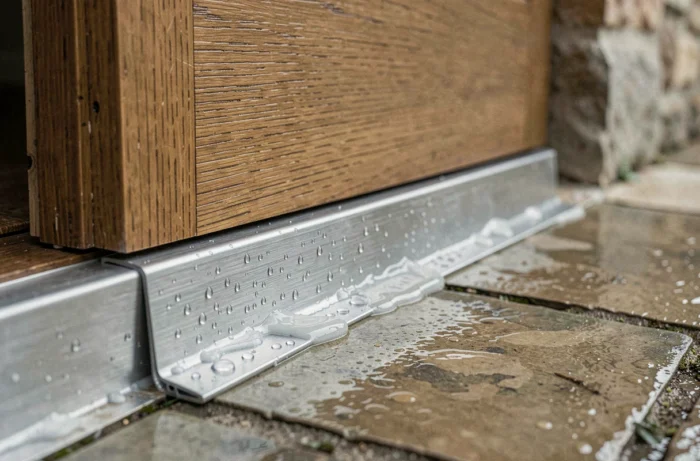
PPRI and legal obligations: what your municipality may require
Flood Risk Prevention Plans (PPRI) approved by prefectures may require owners of existing homes to implement protective devices, including flood barriers. A PPRI may set a compliance deadline of five years and cap the cost of required work at 10% of the property’s market value.
Consulting your municipality’s PPRI before starting work allows you to adapt the level of protection to regulatory requirements. A handmade barrier may suffice for a moderate risk, but a PPRI classifying your plot in a high-risk zone will steer you towards a certified flood barrier, sized for a specific water height.
Funding: the Barnier fund
The major natural risk prevention fund (Barnier fund) can finance part of the protective work required by a PPRI. The amount of the grant depends on the type of property and the nature of the improvements. Inquire with your town hall or the departmental directorate of territories to learn about the applicable terms for your situation.
Maintenance and storage of a removable rain barrier
A removable flood barrier stored in a damp garage for years loses its seals and fixings. Maintenance determines reliability at the critical moment.
After each use, rinse the seals with clear water to remove abrasive particles (sand, gravel) that degrade the rubber. Store the device upright, in a dry place, without any load resting on the seals. Once a year, manually compress each seal to check that it returns to its original shape. A seal that remains crushed no longer guarantees sealing.
For reusable sandbags, empty and dry them after use. Wet sand stored in a polypropylene bag promotes mold and weakens the fabric in a few months.
The reliability of flood protection relies as much on the initial installation as on regular checks. A well-installed flood barrier on a prepared threshold, with side seals in good condition and a verifiable performance report, covers the vast majority of runoff events that a house is exposed to.