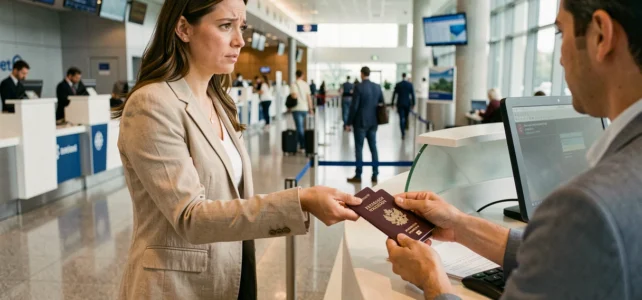
An airline ticket booked in the wife’s name, a passport displaying the birth name in the machine-readable zone: the discrepancy is enough to block boarding. The problem does not always stem from an error by the person making the reservation. It often arises within the booking chain itself, between the traveler profile, the online agency, and the airline’s system.
The name on the ticket does not always come from you
Most articles on the subject assume that the passenger has incorrectly entered their name. This is sometimes true. However, in a significant number of cases, the name displayed on the boarding pass results from an automatic rewrite that the passenger is unaware of.
Further reading : How to Simplify Your Real Estate Processes with Online Real Estate
Three links can modify or truncate a name between the reservation and the boarding control:
- The airline loyalty profile, created years ago with the wife’s name, which overrides the name entered during the reservation as soon as the member number is linked to the file.
- The online travel agency (OTA), which reformats the name/first name fields according to its own rules and may merge or reverse compound names.
- Code-share flights, where the PNR (passenger record) is duplicated from one airline to another with fields sometimes truncated or reorganized.
The result: a passenger who has correctly entered their birth name may find themselves with a ticket bearing their wife’s name, or vice versa, without having touched the form. This discrepancy remains invisible until the boarding gate or, worse, until border control at the destination.
Further reading : How to Optimize Your Business Performance with Custom IT Solutions
When discussing boarding denial due to the wife’s name, the issue goes beyond mere distraction at the time of booking. It is the entire name transmission chain that can generate the error.

French passport and wife’s name: what the scanner actually reads
On a French passport, the birth name always appears in the machine-readable zone (MRZ), those two lines of characters at the bottom of the identity page. The wife’s name, when mentioned, appears in the upper visual zone, preceded by the mention “ép.”.
The scanner of the boarding agent or the automatic gate reads the MRZ. It compares the data read with that of the PNR transmitted by the airline. If the ticket bears the wife’s name and the MRZ the birth name, the match fails.
The mention “ép.” on the passport does not appear in the MRZ. It therefore has no value for the automated system. A human agent can, in theory, make the connection manually, but field reports show that this tolerance varies depending on the airline, the airport, and the staff present. Relying on the goodwill of an agent at the boarding gate exposes one to a flat-out denial.
The case of destinations outside the European area
Some destinations apply strict identity rules at the borders. The United States, for example, require that the name on the ticket exactly matches the machine-readable name on the passport. Any discrepancy, even the addition of a common name, can trigger a report or a denial of entry.
The safest rule remains to use the name as it appears in the MRZ of the passport, without addition or variation. This applies to the ticket, the loyalty profile, and any electronic travel authorization request (ESTA, ETA, or equivalent).
Check the consistency of the name at every stage of the booking
The check should not be limited to the initial entry. A correct name at booking can be altered later. Here are the verification points not to overlook:
- After booking, open the e-ticket summary (not the payment confirmation, but the transport document) and check that the name matches the MRZ of the passport, character by character.
- If a loyalty program is linked, check the name registered in the profile. A profile created before a marriage or divorce may contain an outdated name that will be injected into the PNR.
- In case of booking through an online agency, request the PNR directly from the airline to verify what has been transmitted. OTAs do not always provide transparent access to the actual file.
- For connecting flights operated by a different airline (code-share), check each segment separately. The name may have been reformatted during the transfer between booking systems.
This verification takes a few minutes. It avoids a situation where the correction incurs modification fees, when it remains possible, or a repurchase of the ticket when the airline refuses any rectification.
Correction of the name on an airline ticket: real margins for maneuver
Name change policies vary from one airline to another. Some allow a minor correction (typo, inversion of first name/last name) for free or for a moderate fee. Others consider any name change as a new booking.
Online agencies often complicate the procedure, as they act as intermediaries and the airline may refuse to deal directly with the passenger. Testimonials on travel forums describe situations where the agency promises a modification that is never carried out, sometimes for weeks.
When departure approaches and the correction has not been made, there remains a last resort option: show up at the airport with the passport, family book, or marriage certificate, and attempt to obtain manual validation at the check-in counter. Field reports vary on the effectiveness of this approach. Some passengers pass without difficulty, while others are denied boarding despite the supporting documents.
Anticipate rather than improvise
Traveling systematically with a copy of the family book or marriage certificate does not guarantee anything, but provides a minimal safety net. The proof of the link between the two names must be anticipated, not improvised at the airport.
The most effective reflex remains upstream: book under the birth name as it appears in the MRZ, update loyalty profiles after each change in civil status, and verify the PNR transmitted to the airline after any booking through an intermediary. The wife’s name is a usage right, not an identity in the sense of airline systems. This distinction, however technical it may be, makes the difference between smooth boarding and a missed flight.