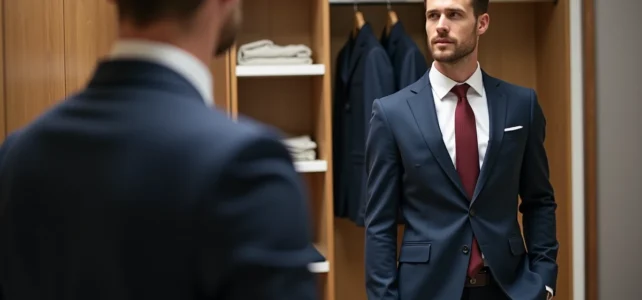
The size of a tie is not just about its total length. Two distinct parameters affect the visual result: the width of the main blade (often referred to as “height” in jargon) and the length including the tip, which determines where the tie falls on the torso. Confusing the two or neglecting one in favor of the other is enough to unbalance an entire outfit.
High-waisted pants and tie drop: the rule that guides forget
Most style advice repeats the same guideline: the tip of the tie should reach the level of the belt buckle. This marker works with standard waist pants. It becomes misleading as soon as the height of the pants changes.
Related reading : Discover the latest news and tips for success in entrepreneurship
With high-waisted pants, the waistband rises on the torso. Following the classic rule visually shortens the torso and gives the impression that the tie is “floating” too high. Specialized sources like Verygoodlord then recommend to aim for the lower third of the jacket rather than the buckle itself, to maintain harmonious proportions.
Conversely, low-waisted pants lower the waistband. The tie appears too long if it follows this new marker. It is better to understand the size and height of ties as a system of proportions relative to the torso, not as an absolute measurement based on a belt accessory.
See also : Tips and Tricks for a Fulfilling Family Life Every Day
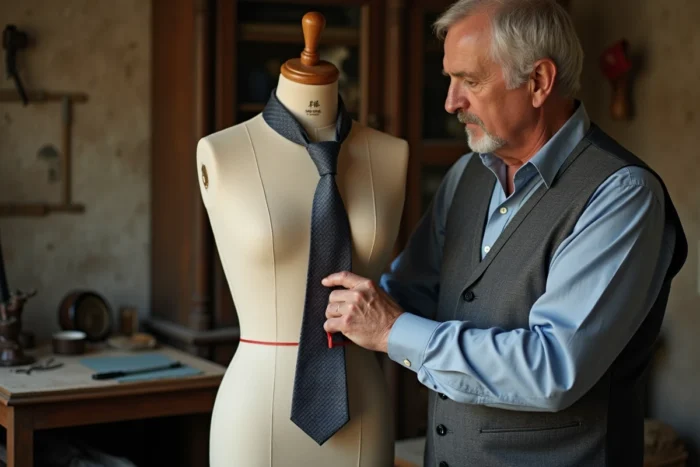
Width of the tie and jacket lapels: the proportion that structures the silhouette
The width of the main blade of a tie is measured at its widest point. It varies by model: slim ties go below six centimeters, classic ones hover around seven to eight, and some wider models exceed this threshold.
The width of the tie should align with that of the jacket lapels. A narrow lapel with a wide tie creates a horizontal imbalance at the collar. The opposite produces the same effect in reverse: the lapel visually crushes a tie that is too narrow.
Check consistency with the shirt collar
The collar of the shirt plays a secondary but real role. A narrow collar (pointed Italian style) pairs better with a slim tie. A cutaway collar, more open, naturally frames a bulkier knot and thus a wider tie.
Before buying, simply lay the tie flat on the open jacket. If the main blade clearly overhangs the lapel, the proportion is broken. This check takes a few seconds and avoids most matching errors.
Type of knot and apparent length: an underestimated lever
The choice of knot directly modifies the visible length of the tie. A full Windsor knot uses significantly more fabric than a four-in-hand (simple knot). On the same tie, the difference in drop between these two knots can represent several centimeters.
A tall man should prefer a simple knot to maximize the useful length. Conversely, a medium-height man can use a half-Windsor or a Windsor to “consume” the excess length without the tip dropping too low.
Adjust the height of the knot to the collar
The position of the knot in the neckline offers a second adjustment lever. By slightly raising the knot against the collar, a few centimeters of visible length are freed downward. By leaving it a bit looser, the drop is shortened. This technique allows a standard tie to be adapted to various body types without resorting to a custom model.
- Simple knot (four-in-hand): minimal fabric consumption, suitable for tall sizes and narrow collars.
- Half-Windsor: intermediate consumption, versatile with most collars and classic suit lapels.
- Full Windsor: maximum consumption, reserved for wide cutaway collars and long ties.

Material of the tie: silk, wool, or cotton depending on the register
The material influences the drop and thus the perception of length. A tie in silk slides and falls straight, which enhances the length effect. A tie in wool or cashmere has more body: it falls with a slight bounce that can visually shorten the drop by a few millimeters.
For a formal suit, silk remains the reference. Its smooth appearance captures light and pairs well with the fine fabrics of dress shirts. Wool or cotton are better suited for casual outfits or tweed jackets. Their matte texture creates a pleasant contrast with striped or polka dot patterns.
Patterns and illusion of proportions
Diagonal stripes (regimental stripes) visually elongate the tie. Polka dots or micro-patterns have a neutral effect. Horizontal stripes, rare on ties, widen the blade and can give the impression of a shorter tie.
A quality fabric retains its shape after the knot, without wrinkling or buckling. This criterion is as important as color or pattern: a tie that twists after an hour of wear loses all visual hold, regardless of its theoretical length.
- Silk: straight drop, shine, formal register. Ideal with a fine wool suit.
- Wool or cashmere: shorter drop, matte texture, semi-formal register.
- Cotton: soft drop, casual appearance, suitable for summer outfits without a jacket.
- Blends (silk-wool, silk-linen): compromise between hold and lightness depending on the season.
The choice of a tie is based on a system of proportions: width aligned with the lapels, length adjusted to the type of pants and the chosen knot, material consistent with the outfit’s register. Mastering these three parameters avoids most style mistakes, without needing to multiply models in one’s wardrobe.