How to distinguish French brands of organic baby bedding when most make the same promises of organic cotton and responsible manufacturing? The criteria that truly separate these players relate to their textile certifications, their production location, and their compliance with recent safety standards. This comparison scrutinizes the verifiable elements to clarify a choice often drowned in marketing.
Comparison table of French organic baby and children’s bedding brands
The brands below focus on home textiles (sheets, sleeping bags, crib bumpers, bath capes) made from organic cotton, with design or manufacturing located in France or Europe. The table summarizes their stated commitments.
| Brand | Key Products | Organic Certification | Manufacturing Location |
|---|---|---|---|
| Little Crevette | Bedding, bath capes, sleeping bags | Organic cotton (GOTS announced) | Europe |
| La Pommeraye | Fitted sheets, duvet covers, sleeping bags | Certified organic cotton | France / Europe |
| Poudre Organic | Sleeping bags, muslins, bedding | GOTS | Europe (Portugal, certified India) |
| Petit Picotin | Cradle bedding, textile newborn gifts | Natural materials, variable label | France |
| Crapouillette | Textile accessories, children’s bedding | GOTS (large part of the range) | France (Loire) |
The GOTS label (Global Organic Textile Standard) remains the most reliable reference: it covers the production chain from the cotton field to manufacturing, incorporating social criteria. A mention of “organic cotton” without certification details does not guarantee the same level of traceability.
Among these players, La Pommeraye’s organic cotton fitted sheets stand out for their focus on functional bedding, with dimensions suitable for standard and evolving baby mattresses.
GPSR Regulation and Baby Bedding Safety: What’s Changing
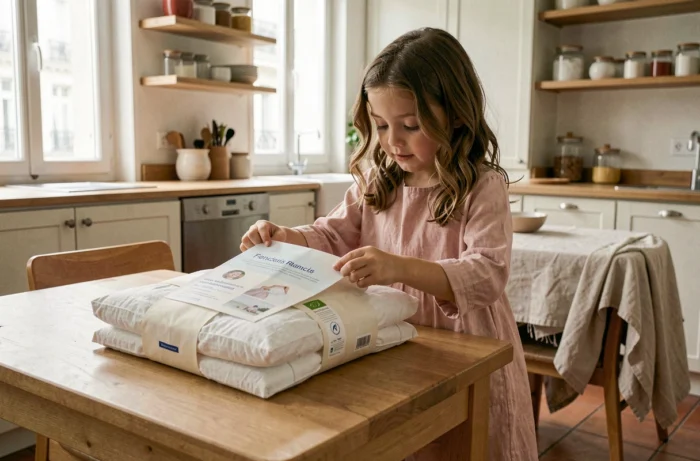
Most brand comparisons overlook a recent regulatory turning point. The Regulation (EU) 2023/988 on the general safety of products, known as GPSR, is applicable from December 13, 2024. It does not only concern toys or clothing: any baby textile in prolonged contact with the skin (sheets, sleeping bags, blankets) falls within its scope.
The obligations are concrete. Each brand must now provide a documented risk assessment, technical documentation, and a declaration of conformity. Marketplaces like Amazon or Etsy may refuse to list a product if these elements are missing.
For a parent, the consequence is simple: a brand compliant with GPSR guarantees a higher level of control than what prevailed before this date. Asking the manufacturer about their GPSR compliance before purchasing bedding for an infant becomes a relevant reflex, just like checking the cotton certification.
EN 16781 Standard for Sleeping Bags
Sleeping bags and angel nests have their own European standard, EN 16781. It regulates risks related to cords, closures, and the size of the product in relation to the child’s age. A French brand that displays this compliance goes further than a simple commitment to organic materials.
GOTS Certification vs. “Organic Cotton” Mention: The Real Differences
Displaying “organic cotton” on a label does not require any external audit in France if the brand does not claim a specific label. Only GOTS certification imposes an annual inspection by an independent organization, covering both the absence of pesticides, working conditions, and wastewater treatment.
Among the brands in the comparison, Crapouillette and Poudre Organic explicitly mention the GOTS label on a large part of their range. Other players indicate “organic cotton” without specifying the reference. The difference is not trivial:
- A GOTS product strictly prohibits chlorinated bleaching agents, azo dyes, and heavy metal residues beyond strict thresholds
- GOTS traceability goes back to the farm, allowing verification of the exact origin of the fiber
- The social aspect of GOTS requires compliance with the International Labour Organization conventions throughout the chain
However, a brand that manufactures entirely in France with certified raw materials offers a geographical traceability that the GOTS mention alone does not cover. The ideal remains the combination of a material label and localized manufacturing.
French or European Manufacturing: Where is the Line?
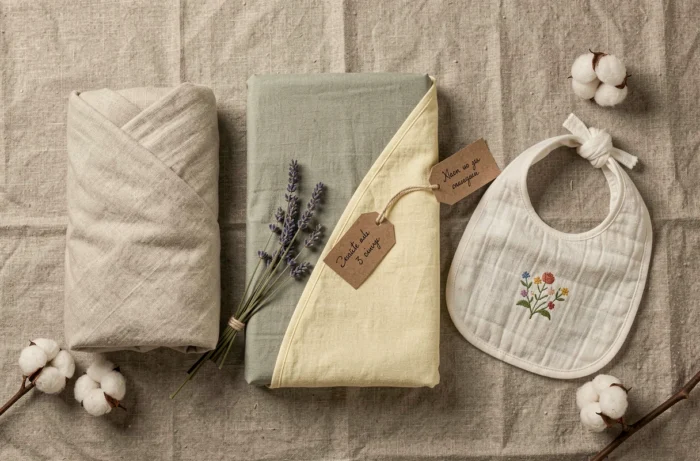
The “made in France” label applied to baby bedding encompasses very different realities. Some brands design in France but manufacture in Portugal, Tunisia, or India. Others, like Crapouillette in the Loire, keep all production within the territory.
Organic cotton does not grow in mainland France. The raw material generally comes from India, Turkey, or Egypt. The relevant criterion is therefore the location of weaving, dyeing, and manufacturing, not the origin of the raw fiber.
Three questions to ask before buying organic bedding for babies:
- Is the weaving done in France or Europe, and by which workshop?
- Does the dyeing use certified processes (GOTS, Oeko-Tex) with wastewater treatment?
- Does the brand have a consultable GPSR declaration of conformity?
The answers to these three points reveal more about the actual quality of the product than any photo of a cotton field on an e-commerce site.
The French market for organic baby and children’s bedding is maturing with the GPSR and the rising demands of labels. Brands that combine GOTS certification, traceable manufacturing, and regulatory compliance for 2024 remain in the minority. It is precisely this trio of criteria that separates a truly safe purchase from a mere marketing argument.