
An electric hedge trimmer rated at 500 or 600 W with a 50 cm blade seems to tick all the boxes on a product sheet. However, the difference between the nominal power measured at idle and the tool’s performance against a dense privet hedge or a waterlogged laurel after rain can be surprising. Understanding what separates manufacturer data from actual performance allows for a choice that lasts over several seasons.
Announced Power and Actual Performance on Dense Hedges
The wattage indicated on the packaging corresponds to the electrical consumption of the motor, not the energy actually transmitted to the blades. Some energy is lost as heat, vibrations, and mechanical friction in the cutting mechanism.
See also : How to Choose the Best Free Reverse Mobile Directory to Find a Number
On a young and flexible hedge, the difference remains imperceptible. However, on woody or wet branches, the motor slows down, the blades struggle to shear, and the user compensates by forcing the action. The result: an uneven cut, crushed branches instead of cleanly cut ones, and premature arm fatigue.
Two technical parameters explain the actual cutting capacity better than raw power: the spacing of the teeth (the distance between two consecutive teeth, which determines the maximum branch diameter accepted) and the blade rotation speed, often expressed in strokes per minute. A model with generous spacing and a high cutting rate will cut through a mature hedge much more easily than a more powerful device in watts but equipped with closely spaced teeth.
Further reading : How to Choose the Best Pet Insurance in 2024: Our Complete Guide
To compare models based on concrete criteria, the detailed sheets available on taille-haie-warrior.com allow for side-by-side comparison of these technical data.
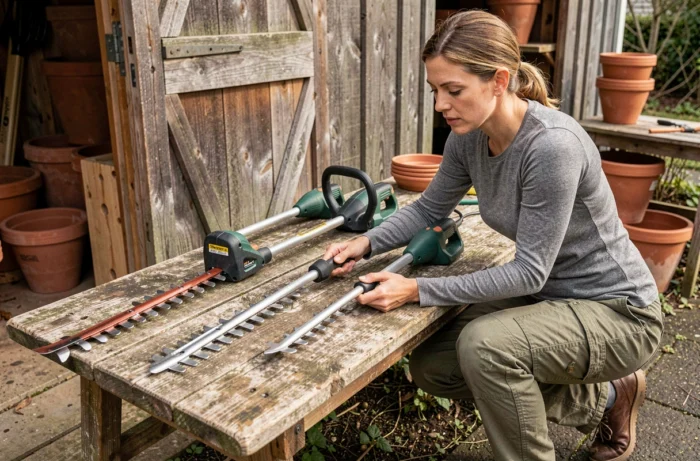
Wired, Battery, or Gas Hedge Trimmer: Comparison Table
The power source affects weight, freedom of movement, and budget. Here’s a summary of the characteristics that matter in real situations.
| Criterion | Wired Electric | Battery | Gas |
|---|---|---|---|
| Average Weight | Lightest | Intermediate (battery included) | Heaviest |
| Range | Limited by extension cord | Free, depends on battery life | Free, depends on tank |
| Noise Level | Low | Low to moderate | High |
| Cutting Capacity on Hard Wood | Moderate | Moderate to good (depending on battery voltage) | High |
| Maintenance | Minimal | Battery and charger management | Oil change, filter, spark plug |
| Entry Budget | Lowest | Intermediate | Highest |
The wired model is suitable for short hedges located near the house. The battery model offers the best compromise between mobility and maintenance for a medium-sized garden. The gas model remains relevant for long stretches and very thick hedges where continuous cutting power makes a difference.
Battery Life: The Gap Between Technical Sheet and Real Use
Manufacturers measure battery life under standardized conditions, often on light cuts and at a regular pace. In real use, facing more resistant vegetation, the actual battery life is often less than advertised.
Several factors accelerate discharge:
- Wet or semi-woody branches increase mechanical resistance and put more strain on the motor with each pass
- A dull or sap-clogged blade forces the motor to work harder, consuming more energy per cut
- Low outdoor temperatures reduce the actual capacity of lithium-ion cells, sometimes significantly in early spring
For gardens that require more than half an hour of continuous trimming, having a second compatible battery prevents work interruptions. Compatibility between batteries deserves careful verification: not all models from the same manufacturer are interchangeable across ranges, even with the same voltage.
Blade Length and Tooth Spacing: Choose According to Your Hedge
The blade length determines the cutting width in a single pass. A short blade (around 45 cm) is easy to handle for rounded shapes or precise finishes. A longer blade (60 cm and above) covers more surface area and is suitable for straight hedges, but it makes the tool heavier and vertical cuts more tiring.
The spacing of the teeth determines the maximum branch diameter that the tool can cut cleanly. Wide spacing accommodates thicker branches without jamming. Close spacing produces a neater finish on fine shoots but gets stuck on hard wood.
For a mixed hedge composed of broadleaf and some semi-woody branches, an intermediate spacing offers the best balance. Fast-growing conifer hedges, which mainly produce soft shoots, can do with reduced spacing.
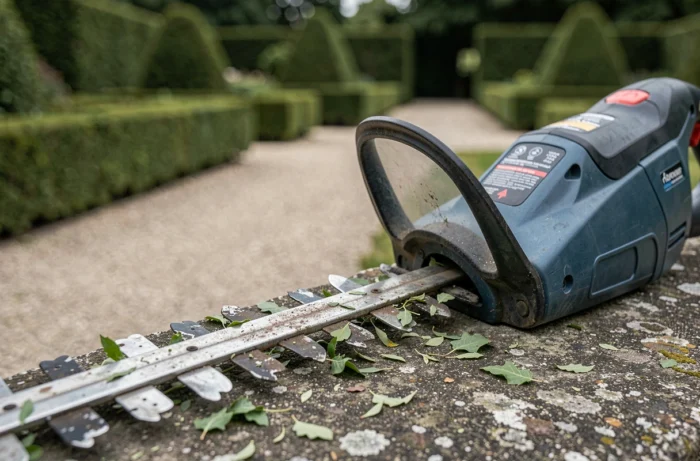
Ergonomics and Safety of Electric Hedge Trimmers
The weight of the device, its distribution, and the design of the handle directly influence how long one can work without pain. A poorly balanced hedge trimmer pulls forward and puts asymmetric strain on the wrist.
A rotating handle (pivoting 90° or more) makes vertical cuts and working on top of the hedge easier without having to lift the arms above shoulder height. This detail, rarely highlighted on product sheets, significantly reduces fatigue during prolonged sessions.
In terms of safety, almost all electric models incorporate a dual control system: both hands must press simultaneously for the blades to operate. A protective guard at the blade tip limits the risk of accidental contact with a wall or fence. The French Office for Biodiversity recommends avoiding any trimming from March 15 to July 31, during the bird nesting period.
The choice of an electric hedge trimmer relies less on the displayed power than on the suitability between tooth spacing, blade length, and the type of hedge to maintain. Checking the actual battery life, battery compatibility, and handle ergonomics before purchase remains the most reliable way to avoid a tool that disappoints at the first encounter with a somewhat tough hedge.