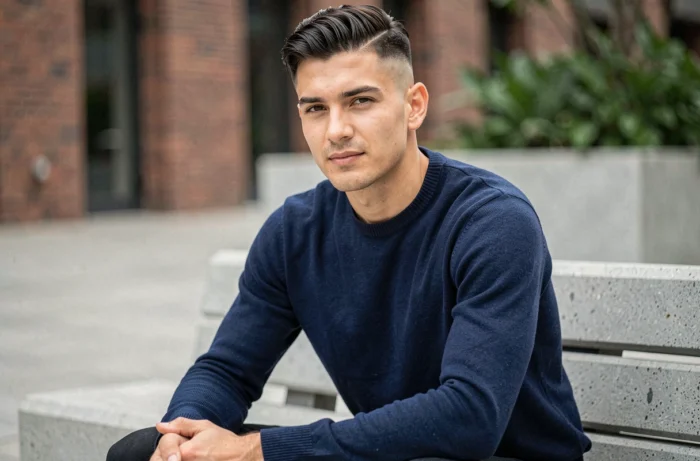
The fade on medium-length hair is no longer just a clean blend at the temples. For a few seasons now, the medium-length men’s haircut has changed its logic: scissor work is increasingly replacing clippers, the transitions between lengths are becoming gradual, and volume is managed from within the cut rather than through a harsh contrast. Understanding this evolution allows for choosing a style that lasts over time, not just on the day of leaving the salon.
Progressive taper and slick back: the medium-length cut that has replaced the fade
Have you noticed that very marked fades, with a clear line between the short and long areas, are becoming rarer? In salons, hairstylists now favor a progressive taper with scissors rather than a clipper fade. The difference is simple: instead of a sharp contrast, the length gradually decreases from the top of the head to the nape and temples.
This soft taper often combines with a modern slick back. The hair is swept back, but without being excessively flattened. Thinning creates a slight imbalance between the front and back, giving a natural movement. The result appears less rigid than a classic undercut.
To explore other medium-length men’s fade hairstyle ideas, this type of progressive taper is an excellent starting point, especially if you’re looking for a polished look without needing touch-ups every three weeks.
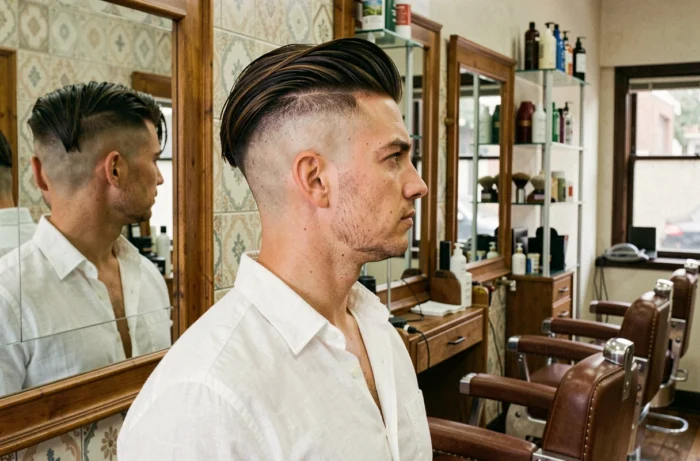
Medium-length fade for fine hair: gaining volume through internal structure
Most guides talk about visual styles (man bun, wavy, slick back) without addressing a technical question that changes everything for fine hair: how to create volume without cheating with products.
The answer lies in the internal construction of the cut. On fine, medium-length hair, an experienced hairstylist works on internal layers that support the top strands. The fade may not be visible from the outside, but it structures the hair mass from within.
Invisible layering technique
The principle is to cut short layers at the base, invisible beneath the upper lengths. These layers create a natural spring effect. Fine hair appears denser without adding artificial volume.
This approach is very different from a classic fade that removes material from the sides. Here, we keep the material and redistribute it. It’s a cutting strategy particularly suited for men who want to maintain a medium length without the “flat hair” effect at the temples.
- Ask your hairstylist for an internal thinning rather than an overall thinning, which would further refine already fine hair.
- Avoid clippers on the sides: scissors allow you to keep enough density so that the transition remains full.
- Dry your hair by lifting it at the roots, head down, to activate the volume created by the internal layers.
Wavy perm and fade: the duo that redistributes volume
The men’s perm is making a strong comeback, and its combination with the medium-length fade deserves attention. We’re not talking about the tight curls of the 1980s. The wavy perm creates wide, soft waves that transform the texture of a medium-length cut.
At this length, the fade changes its role. It no longer serves only to shorten the sides. It becomes a tool to distribute volume around the face and on the sides, avoiding the pyramid effect that waves can cause on thick hair.

How the fade controls the perm
Without an appropriate fade, a perm on medium-length hair expands uniformly. The result can look bulky, especially around the ears. By gradually removing weight from the side and nape areas, the hairstylist channels the curls where they add character (the top, the fringe) and lightens them where they weigh down the silhouette.
This cutting work is done before the perm, not after. The fade precedes the texture; it does not correct it. A good salon first offers a structured cut, then applies the chemical treatment.
Maintenance of the medium-length fade: frequency and concrete actions
A progressive taper with scissors lasts longer than a clipper fade. The regrowth blends naturally into the cut instead of creating a visible line after two weeks. Generally, plan for a visit to the hairstylist every six to eight weeks to maintain the shape, compared to three to four weeks for a short fade.
- Between cuts, a light texturizing balm is enough to redefine movement without weighing down the lengths.
- Avoid strong-hold gel: it stiffens the strands and negates the natural effect of the progressive taper.
- If you have a wavy perm, a sea salt spray revives the waves without a complete wash.
- Ask your hairstylist to show you the drying technique suited to your cut: the blow-drying technique changes depending on whether the fade is internal or visible.
The current medium-length fade is distinguished by its technical subtlety. The trend is no longer for spectacular contrast but for a cut that works with the natural texture of the hair. Whether you opt for a sober slick back, an internal construction for fine hair, or a controlled wavy perm, the common thread remains the same: a fade thought of as architecture, not just a simple shortening of the sides.